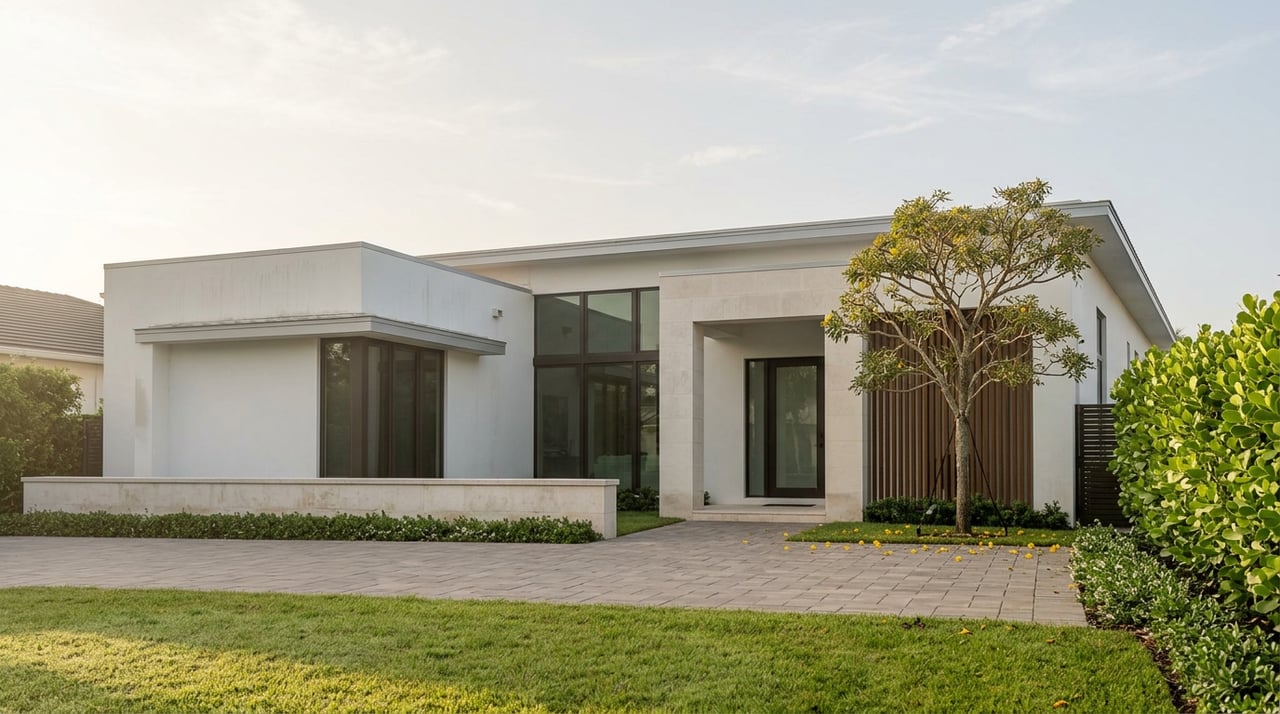
A 6,800-square-foot house at 6060 Southwest 118th Street went under contract this month asking $9.6 million. Do the math and that's $1,400 a square foot. Built in 2023, it comes with seven bedrooms, eight full bathrooms, a pool, and a private tennis court. The owners, Daphne Assali Martino and Jeffrey G. Martino, bought the lot and whatever stood on it for $1.1 million back in 2020. Kameel Jiwa and Mario Beltran Tolosa hold the listing.
Now compare that number to the number everyone quotes for Pinecrest as a whole. As of August 2026, active single-family listings across the village carried a median list price of $4.75 million, or $948 a square foot. That's a $452 gap on the same street grid, inside the same school zone, under the same village government. The gap isn't noise. It's the clearest evidence that Pinecrest doesn't have one housing market. It has two, and the zoning code is what splits them apart.
Two Products, One Zoning Code
Most of Pinecrest's residential land carries EU-1 estate zoning, a designation built around a one-acre lot pattern the village's own code does not permit to be subdivided. That single rule is doing more work than any amenity list. It means the number of buildable home sites in the village is fixed. Nobody is carving a half-acre lot into two quarter-acre lots to add inventory. The parcel count today is close to the parcel count Pinecrest will have for the foreseeable future.
The housing stock built on top of that fixed land base spans about seventy years, from the original 1950s and 1960s ranch houses that established the acre pattern in the first place, through to construction finished this year. Both ends of that range trade actively in the same market. That's the actual structure buyers are stepping into: not a single price curve, but two products competing for the same acre-scarce land.
What the Ranch Actually Costs
Miami-Dade sits inside Florida's High-Velocity Hurricane Zone, the most demanding wind-design standard in the state building code. A house built to that current code arrives with impact-rated glazing, modern roof attachment, and electrical and plumbing systems young enough to insure without a fight. A 1960s ranch on a full acre generally does not have any of that. It has the acre. What it doesn't have is a roof, windows, or wiring an insurer will underwrite at today's rates without upgrades, and those upgrades aren't cosmetic. They're structural.
That's the real reason the ranch trades at a lower price per square foot. It isn't cheaper because it's worse. It's cheaper because the buyer is pricing in a construction project the new-build buyer already paid someone else to finish. For an out-of-state buyer who doesn't want to manage a hurricane-code retrofit from another city, that difference isn't academic. It's the entire negotiation.
| 1960s Ranch, Full Acre | New Construction, Half Acre | |
|---|---|---|
| Lot size | Roughly 1 acre | Roughly 0.5 acre |
| Building systems | Pre-code, typically needs roof, glazing, electrical work | Current Florida Building Code, insurable as-is |
| Price anchor | Below village median $/sq ft | At or above $1,400/sq ft in recent comps |
| What you get | Room for guest house, pool, sport court, motor court | Turnkey systems, no renovation timeline |
| What you give up | Move-in readiness | One or more of the amenities the full acre allows |
The Half-Acre Trade
A buyer who wants a detached guest structure, a pool, a sport court, and a motor court on one parcel is describing an acre's worth of program. On a half-acre, those uses start competing with each other for space, and something has to lose. In practice, that usually means one of the following gets cut before the house ever breaks ground:
- The detached guest structure, if the pool and motor court are non-negotiable
- The sport court, if the family wants a full guest house and a real yard around the pool
- The motor court, replaced by a shared driveway that also serves the garage
There's no version of the half-acre lot where a buyer gets all four. The acre is the only lot size where that math works, and the acre supply is capped by the same zoning that makes it valuable.
Why the Median Doesn't Show This
Here's where the county-level number actively misleads a buyer instead of just simplifying things for them. A single village-wide median or average blends a fixed-supply acre lot against a fixed-supply half-acre lot, a fully renovated house against a house that needs $300,000 in roof and window work, and an inland flood zone against a flood zone that runs along the Snapper Creek corridor on the other side of the village. None of those distinctions show up in a single number. All of them show up in the closing statement.
The gap between the median and the average tells the same story from a different angle. Recent MLS-sourced figures for active Pinecrest listings put the median asking price at $4.7 million against an average of $6.1 million, a spread driven by a handful of estate-level listings pulling the average well above what a typical Pinecrest home is actually asking. Twelve of the current active listings are waterfront, and none of Pinecrest's waterfront sits on Biscayne Bay. It's canal and creek frontage inland, which carries a different flood and insurance profile than a barrier-island address, and that profile varies parcel by parcel rather than by zip code.
What This Means If You're Comparing
Miami-Dade's broader luxury market cooled into late summer 2026. Countywide weekly luxury contract volume slowed to 12 during the same week that a Pinecrest spec home closed at its full $16.3 million asking price, which tells you something specific about this village: single-family demand inside a zoning-capped supply hasn't followed the county's broader slowdown. Cash still dominates the segment. Miami-Dade logged 847 closed sales priced at $1 million or above during the first quarter of 2026, with cash accounting for roughly 58 percent of those transactions, and that cash concentration tends to move fastest into the kind of scarce, code-compliant inventory Pinecrest's new construction represents.
For a buyer, the actionable question isn't "what's the price per square foot." It's "which half of this market am I actually shopping." If the acre and the space it buys matter more than a move-in date, the ranch inventory is where that trade lives, with a renovation budget built into the offer from day one. If a firm hurricane-code timeline matters more than the extra half-acre, the new-construction inventory is priced for that certainty, and the $1,400-a-foot comp at 6060 Southwest 118th Street is a fair benchmark for what that certainty costs right now.
Buyers considering a non-homestead purchase should also know that Florida currently caps annual property assessment increases at 10 percent for non-homestead property, with that cap resetting to full market value when ownership changes. A statewide ballot measure this November could lower that cap to 5 percent starting in 2027, which would change the carrying-cost math for anyone buying a second home or investment property in the village. Nothing here is tax advice. It's a reason to run the numbers with an accountant before writing an offer, not after.
Pinecrest's zoning isn't going to change the number of acre lots inside the village. What a buyer can change is which side of that fork they're negotiating from, and whether the offer reflects the house that's actually there or the number a countywide average suggested it should be.
If you're weighing a Pinecrest acre against a half-acre new build, or trying to figure out what a specific lot's zoning actually allows, Jordan Karp LLC can walk through the comparable and the code side by side. Let's Connect.